
The country's exports are expected to contract by 5.8 per cent and imports by 11.3 per cent during the second half of the current financial year, though implementation of several measures by the government would help support exports going forward, according to the Economic Survey 2021. With gradual recovery of economic activities, the survey said that imports and exports have picked up. During the first half of 2020-21 (April-September), exports dipped by 21.31 per cent to $125.25 billion while imports declined by 40 per cent to $148.69 billion.
The central bank had in July last year imposed curbs such as doubling of margin requirement and a ceiling on position limits on exchange-traded currency derivatives.

India's current account deficit (CAD) may dip further in the March quarter of FY24 as pressure from the negative net exports during the January-March period eased to an 11-quarter high. A part of the gross domestic product (GDP) data, net export- which is usually negative for India - captures the difference between exports and imports of both goods and services, while the CAD data, released by the Reserve Bank of India (RBI), also factors in private transfer receipts.

India's exports are expected to touch $360 billion in the current fiscal from $312.35 billion in 2013-14, Federation of Indian Export Organisations (FIEO) said.

The Sensex jumped 412.23 points on Friday, braving heavy volatility during the day, amid the Reserve Bank of India maintaining status quo on the benchmark lending rate and buying in index heavyweights Reliance Industries Limited and ITC. The BSE Sensex climbed 412.23 points or 0.70 per cent to settle at 59,447.18. During the day, the benchmark hit a high of 59,654.44 and a low 58,876.36. The Nifty also gained 144.80 points or 0.82 per cent to finish at 17,784.35.

Global trends and trading activity of foreign investors would largely dictate terms in the equity markets this week amid a lack of major domestic triggers, analysts said. Markets may face near-term consolidation due to elevated valuations, they noted. "While the previous week was predominantly shaped by developments in the US Federal Reserve policy, attention will now shift to the Bank of Japan's policy decision on December 19," Santosh Meena, Head of Research, Swastika Investmart Ltd, said.

Clarifying norms for single brand retail trading, government on Tuesday allowed foreign investors to conduct business through more than one joint venture in India.

In days of smart, networked technology and no shame over collateral damage, what will blow up next -- cars, mobile phones, TV sets, refrigerators? And where?, asks Shyam G Menon.

'The challenge in India will be reviving consumption/investment.' 'If the negative surprise in earnings is very sharp or lasts longer than March, it can trigger a sharp sell-off.'

The unilateral pressure by US administration on India, at the behest of US Business Associations lobby through US International Trade Commission investigations and request to USTR to enlist India under Priority Foreign Country under Special 301 review, lacks legitimacy under WTO framework, the signatories to the letter said.

Given the concerns around trade wars that threaten to jeopardise global capital flows as well, attracting foreign capital needs to be a policy priority, says Neelkanth Mishra.

India is a great power that determines its national interests and chooses its partners, Russian Foreign Minister Sergey Lavrov has said, describing as "completely unjustified" the "enormous pressure" on New Delhi due to its energy cooperation with Moscow.

'While Indian markets are indeed not inexpensive, the valuations of largecap stocks are still a considerable distance from being overstretched.'

'What my Labour government will seek with India is a relationship based on our shared values of democracy and aspiration. That will seek a free trade agreement (FTA), we share that ambition, but also a new strategic partnership for global security, climate security, economic security'

Bibek Debroy raised seven questions about the new institution.

Reports (not denied by India) that the USA had 'for the first time provided real-time details to their Indian counterparts on the Chinese positions and force strength in advance of a PLA incursion' into Tawang at the LAC in December 2022, helping India thwart China's expansionist designs, show how operationally effective the USA-India friendship has become on the ground. A engaging excerpt from Sreeram Chaulia's must-read new book, Friends: India's Closest Strategic Partners.

JSW Steel was the biggest gainer on the Sensex chart, rising 2.68 per cent, followed by Tata Motors, Mahindra & Mahindra, Tata Steel, Titan, ITC, Tech Mahindra, NTPC, Reliance Industries and Larsen & Toubro. In contrast, Bajaj Finance, Maruti, ICICI Bank, Power Grid, Asian Paints and Axis Bank were major laggards.

Equity benchmark Nifty scaled the psychological milestone of 21,000 in afternoon trade on Friday, and the Sensex touched its all-time intraday high of 69,888.33 after the central bank's decision to keep policy rates unchanged in line with market expectations. The 50-share benchmark index opened on a bullish note, after taking a breather on Thursday, and rose to 21,006.10. As many as 25 stocks were trading in the green, and 24 stocks defied the broader market and were trading in the negative territory.

Speaking at a programme in Kolkata on Tuesday night, he said that in the past, even the US has been appreciative of the fact that the Chabahar port has a larger relevance.

Titan was the top gainer in the Sensex pack, rising 3.5 per cent, followed by Kotak Bank, SBI, Maruti Suzuki, Bajaj Finance, HUL, Axis Bank and Sun Pharma. On the other hand, NTPC, Tech Mahindra, PowerGrid and Infosys were the laggards.

The trigger that led Japan and the Philippines to ink the deal was because of the deteriorating security situation in the South China Sea. China's coast guard increased the frequency and intensity of incursions into Philippine waters, provoking the Philippines to take countermeasures to deter China, explains Dr Rajaram Panda.

'Clearly, there is a wide gap between the stated intentions of China's top leadership to improve relations with India and the PLA's aggressive border management,' says Brigadier Gurmeet Kanwal (retd).

But their trajectory and direction have been largely influenced by politics and the political leadership's understanding of how the economy needs to be managed, explains A K Bhattacharya.

Bangladesh is in turmoil, which is not good news for India, which shares a porous 4000 km border with it. There is a danger of fundamentalism growing there, and India has to move in to reset its ties with the new dispensation before China and Pakistan make capital out of it, alerts Ramesh Menon.

Improved monsoon, solid fiscal performance, and capex push by the public and private sectors augurs well for India's macroeconomic stability and growth, the finance ministry's monthly economic review for June 2023 said. But the report said that while India's domestic fundamentals remain strong, negative cross-border spillovers and adverse global developments could act as a deterrent in achieving the high growth path this financial year. "An improved matching of aggregate supply and aggregate demand in the Indian economy underpins the progress made in the control of domestic inflation and the consequent strengthening of macroeconomic stability," the review said.

The 'BluFin Business Cycle Indicator', which reflects various macroeconomic trends on a monthly basis, stood at 166.3 points in May, 5.8 per cent higher compared to the same month last year, suggesting that the Indian economy is growing at a faster rate than the previous year.

Macroeconomic data announcements, global trends and trading activity of foreign investors would guide momentum in the equity market this week, analysts said. Markets ended a five-week losing streak and gained nearly a per cent last week, helped by a sharp rebound on Friday. Last week, the BSE benchmark jumped 500.65 points or 0.77 per cent and the Nifty gained 169.5 points or 0.87 per cent.

Global trends, trading activity of foreign investors and movement of oil benchmark Brent crude would dictate terms in the domestic markets this week, analysts said. Equity markets, which fell nearly 3 per cent last week, may face volatile trends amid the monthly derivatives expiry on Thursday. "This week marks the September month Futures and Options (F&O) expiry, which is expected to bring about volatility in the market," said Santosh Meena, Head of Research, Swastika Investmart Ltd.
The Reserve Bank has told the International Monetary Fund (IMF) that the objective of frequent interventions in the forex market is to curb excessive volatility, dismissing the Fund's rationale for reclassifying India's exchange rate regime. The IMF, following the Article IV consultation with the Indian authorities, reclassified the status of the exchange rate regime to "stabilised arrangement" from "floating" for period between December 2022 to October 2023. India's Executive Director at IMF K V Subramanian and Senior Advisors Sanjay Kumar Hansda and Anand Singh questioned the selection period adopted by the Fund for analysis and also reclassification of the country's exchange rate regime.
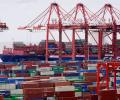
After staging a strong recovery from COVID-induced slowdown in 2021, India's exports are likely to extend the growth story to the New Year also on increased demand in the global markets, boost in domestic manufacturing due to production-linked incentive schemes and implementation of some interim trade pacts. Expectations of positive growth in the country's exports are also backed up by the outlook of the World Trade Organisation (WTO) which predicts a 4.7 per cent expansion in the global merchandise trade volume in 2022. Exporters believe that the outbound shipments would cross $400 billion mark in this fiscal going by the current momentum and may reach $475 billion in 2022-23.

Such campaigns would badly affect players in the traditional retail market.
Market participants attribute the stability to the Reserve Bank of India's timely intervention in the foreign exchange market, both in terms of selling and buying dollars.

Foreign portfolio investors (FPI) have pulled out $3.5 billion from India's equity markets so far this month. The selling comes on the back of election-induced volatility and the rotation of flows from India to China, where stocks are available at half the valuations. If the selling pressure remains at the current level, this will be the highest FPI pullout since January 2023.
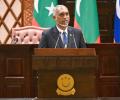
Maldivian President Mohamed Muizzu's party secured a 'supermajority' in Parliament by winning over 60 seats in Sunday's crucial parliamentary election, seen as a litmus test for the pro-Beijing politician whose policies are being closely watched by both India and China amidst regional power dynamics.

'Historically, the markets tend to perform well during election years as governments aim to increase spending and call attention to growth.'

'Higher valuation remains the only spoiler for equities.'

The inflow of cheap capital has also kept the rupee at a high level, making exports uncompetitive and broadening the current account deficit despite falling oil prices.

With the reality of coalition politics staring the BJP in its face, this was inevitable, points out Ramesh Menon.

Global trends, trading activity of foreign investors, outcome of state elections and RBI's interest rate decision are the major factors that will drive the movement in the domestic equity markets this week, analysts said. "Global markets are currently in a fabulous mood. The US 10-year bond yield and the dollar index are also cooling off, which gives strength to the market. These factors will be closely monitored, as they have the potential to influence market sentiment," said Pravesh Gour, senior technical analyst, Swastika Investmart Ltd. On the political front, the results of assembly elections in five states are eagerly anticipated, Gour said.

Applicants for Indian citizenship under the Citizenship (Amendment) Act 2019 (CAA) can submit any of nine documents, including valid or expired passport, ID cards and land tenancy records, to prove he or she is a national of Afghanistan or Bangladesh or Pakistan.
